How to Identify Native Plants
By Scott Bowler Hey, what’s that cool flower? After leading wildflower discovery and identification trips for 40-plus years, I can tell you that people’s most common reaction upon encountering a […]
Read MoreDerek Loeb
Like all biological organisms, flowers are organized by their relative relationship to each other, from huge initial groupings down to what’s most important for us: Family, Genus, and individual species, and, in some cases, localized varieties and sub-species.
One important high level difference is between the type of seedlings and leaf veins that plants have. Monocots have one seed leaf and plants with parallel veins (like pines, grasses, lilies and orchids) and dicots have two seed leaves and plants with branching and net veined leaves (like maples, beans, roses, dandelions, and most other plants).
Understanding a little flower anatomy is fundamental. For one good place to learn the basics, let’s look at the Rosaceae/Rose family, which tend to have:
Flowers can be:
Beyond the flower’s anatomy, look for the general growth habit and form (herb or forb, annual or perennial, woody shrub or tree), size and shape of the leaves (smooth, wavy, toothed, or serrated edges; smooth, shiny, dull, sticky, hairy or bristly surfaces), and the plant’s growth arrangement itself (tall or short, simple or more complex, growing from one central spot or multi-branched).
Flowering plants fall into to broad categories, based upon their seeds and how they sprout: monocots and dicots. After that comes the Family level, which has a unique combination of sexy parts, will make it way easier to identify the Genus and species you have found. The Family provides the most vital identification clues, so it’s good to focus your efforts on learning about the major ones, of which we have many representatives. You’ll quickly find that if you can guess which Family your flower is in, it’s usually pretty easy to go on and figure out at least the Genus and often go on to learn the species.
Within the Monocotyledons, look for these three main flower Families (and please note that I will not be tackling the grasses here because that’s truly a life’s work!):
| Family name -Common | Family name – Scientific | brief description | examples |
| Lily | Liliaceae | showy regular flowers, petals and colored sepals very similar to each other, and arranged in groups of 3s | sand lily, wild onion, cat’s ear/Mariposa/sego lily, yellow bell, camas, death camas, false Solomon’s seal |
| Iris | Iridaceae | showy regular flowers, petals and sepals in 3s but distinctly different, with thicker, more robust leaves than lilies | grass widow, wild iris |
| Orchid | Orchidaceae | showy irregular flowers, meaning top and bottom of the flower have a distinctly different appearance | lady slipper, rattlesnake plantain, coral root |
While there are a great many Dicotyledon flower families, there are a baker’s dozen big, common, well-represented families that contain most of the blooms that you’re likely to encounter in the high desert.
| Family name – Common | Family name – Scientific | brief description | examples |
| Buckwheat | Polygonaceae | most have swollen nodes at leaf joints, lower growing, small showy flowers, often very tough, hardy plants | knotweed, sulfur buckwheat, sorrel, dock |
| Purslane | Montiaceae | usually fleshy leaves, low growing, some very showy blooms | purslane, pussypaws, montia, Lewisia, claytonia/miner’s lettuce |
| Mustard | Brassicaceae | four petals with 6 stamens, inferior and large, showy ovaries, most are edible; | cress and rock-cress, wallflower, mustard, draba, pepper-grass, shepherd’s purse |
| Saxifrage | Saxifragaceae | large and diverse family, name means broken rock (referring to a split ovary), mostly basal leaves; small but showy flowers with four-five petals, showy stamens | prairie stars, alum root, Oregon saxifrage, grassland saxifrage |
| Buttercup | Ranunculaceae | sepals and petals colored, many stamens, superior multiple ovaries | sagebrush buttercup, Blue Mountain buttercup, western, and other buttercups, larkspur, delphinium, columbine, clematis, pasqueflower |
| Rose | Roseaceae | very large, diverse family, usually five green sepals with five colorful, showy petals, forbs, shrubs, trees and vines, many have edible fruits | wild rose, horkelia, ocean spray, geum, strawberry, partridgefoot, avens, potentilla, bitter-brush, raspberry, hackberrry |
| Pea | Fabaceae | irregular flowers, with a “bonnet” at top and a “keel” at the bottom, often bi-colored, showy, usually compound leaves | vetch, loco weed, lupine, woolly-pod milk vetch, giant-head clover, prairie-clover |
| Violet | Violaceae | irregular flowers, 2 petals up and 3 down with landing lines for pollinators, showy | sagebrush violet, yellow prairie violet, and out towards Idaho the gorgeous Beckwith’s violet |
| Evening Primrose | Onagraceae | four petals, very showy, big seedpods | clarkia, fireweed, willow-herb, evening primrose |
| Carrot | Apiceae | flowers tiny in huge clusters arranged like umbrellas, parsley-like foliage, tap roots, NOTE—many edibles, but a few deadly poisonous | lomatum/desert parsley—many varieties, yellow, white and pink, biscuitroot, turkey peas |
| Phlox | Polmoniaceae | five showy petals fused into a long tube, many with tiny, sharp leaves, very tough plants of rocky areas | phlox, scarlet gilia, collomia |
| Borage | Boraginaceae | showy flowers on coiled stalks, often two-toned | popcorn flower, cryptantha, forget-me-not, blue bell, puccoon, fiddle-neck, stickseed |
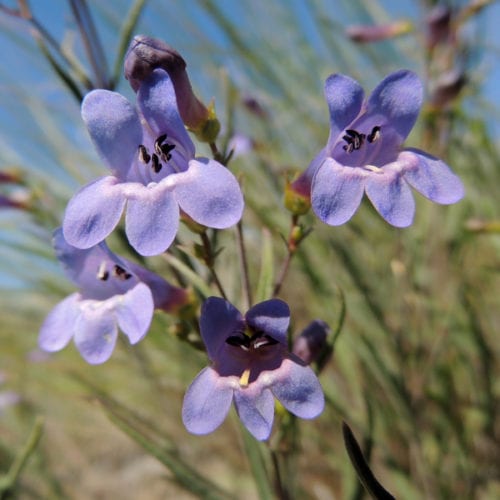
| Figwort | Scrophulariaceae | giant and diverse family of irregular flowers, many oddities and weirdos | pink elephant head, figwort, many penstemons, monkeyflower, lousewort, Indian paintbrush, owl-clover, collinsia |
| Sunflower | Asteraceae | “composite” flowers with two distinct types of flowers present together on a head: ray flowers on the outside (the white daisy “petals”) and the disc flowers on the inside (the yellow center of a daisy) | aster, daisy, Townsendia, arnica, hawksbeard, wild lettuce, agoseris, microseris, rosy everlasting, pussy toes, dirty socks, gold stars, Oregon sunshine, gaillardia, wyethia, balsam root, yarrow, thistles, rabbit brush, sagebrush |
The largest family by far is the gigantic Asteraceae/Sunflower family, which is actually so big and diverse it also includes “tribes!” My personal favorite among those many flowers is the lovely little, no-common-name, Blepharipappus.
Learn to look closely and carefully so that you can spot the differences in key areas, follow your intuition, take lots of photos and write some notes, and you’ll be on your way.
While the unfamiliar might say Oregon’s high desert is “all the same,” well, they are just flat-out wrong. Oregon’s high desert is huge — encompassing about 45% of the state’s land area—and what grows where and when is incredibly varied. Within Oregon’s sagebrush steppe, grasslands, juniper woodlands, rock outcrops, cliffs, salt pans and sand dunes is held a vast diversity of habitat for flora. These habitats are influenced by: rock and soil types, soil chemistry, elevation, slope, sun exposure, aspect, precipitation, temperature, seasonality, competition, invasive species, disturbance, and grazing pressure.
All of these factors, and more, can help you determine what you’re seeing, so it’s vital to pay attention to where and when you’ve encountered a flower. What are the site conditions? Is it early spring, mid-summer or fall? Is the soil damp or dry, sandy or rocky, sparse or deep, salty or not salty? Are you in a shady canyon, out on the hot and sunny flats, or on a steep slope? Are the flowers growing among sagebrush, bitterbrush, greasewood, rabbitbrush, junipers or bunch grasses? Are there a great many of the same kind, or did you find just a few?
The habitat maps in Wildflowers of the Pacific Northwest, the community association lists in Sagebrush Country, and the species checklists in The Nature of Bend all will really help narrow it down, too.
Keep at it. It gets easier with practice!
P.S. If you get really stuck, and you just have to know, please take several photos (of the whole plant, close ups of the flowers and the leaves) and then note the habitat, date, elevation, and location and send me an email with all of that and your question. Have fun and good luck!
Join us for a trip to the Oregon Badlands Wilderness to learn the basics of native plant identification.
Watch nowBy LeeAnn Kriegh Trees live their lives on a different timescale than ours, so it helps to slow ourselves down to fully appreciate them. Certainly, a shrubby little tree like […]
Read More
By Scott Bowler Hey, what’s that cool flower? After leading wildflower discovery and identification trips for 40-plus years, I can tell you that people’s most common reaction upon encountering a […]
Read More